Who it’s for

Coffee roastersRestaurants and cafesBakeriesEverything else
HeardOur workPricingFree toolsAboutContact

A coffee roaster’s store, finished.

We built Barista Plus Coffee a complete Shopify store: the research, the design, 12 coffees, subscriptions, wholesale, a Spanish site, SEO and speed. Will and his team supplied the coffee details and made the calls. We did the rest. It opened to the public on September 26, 2026.

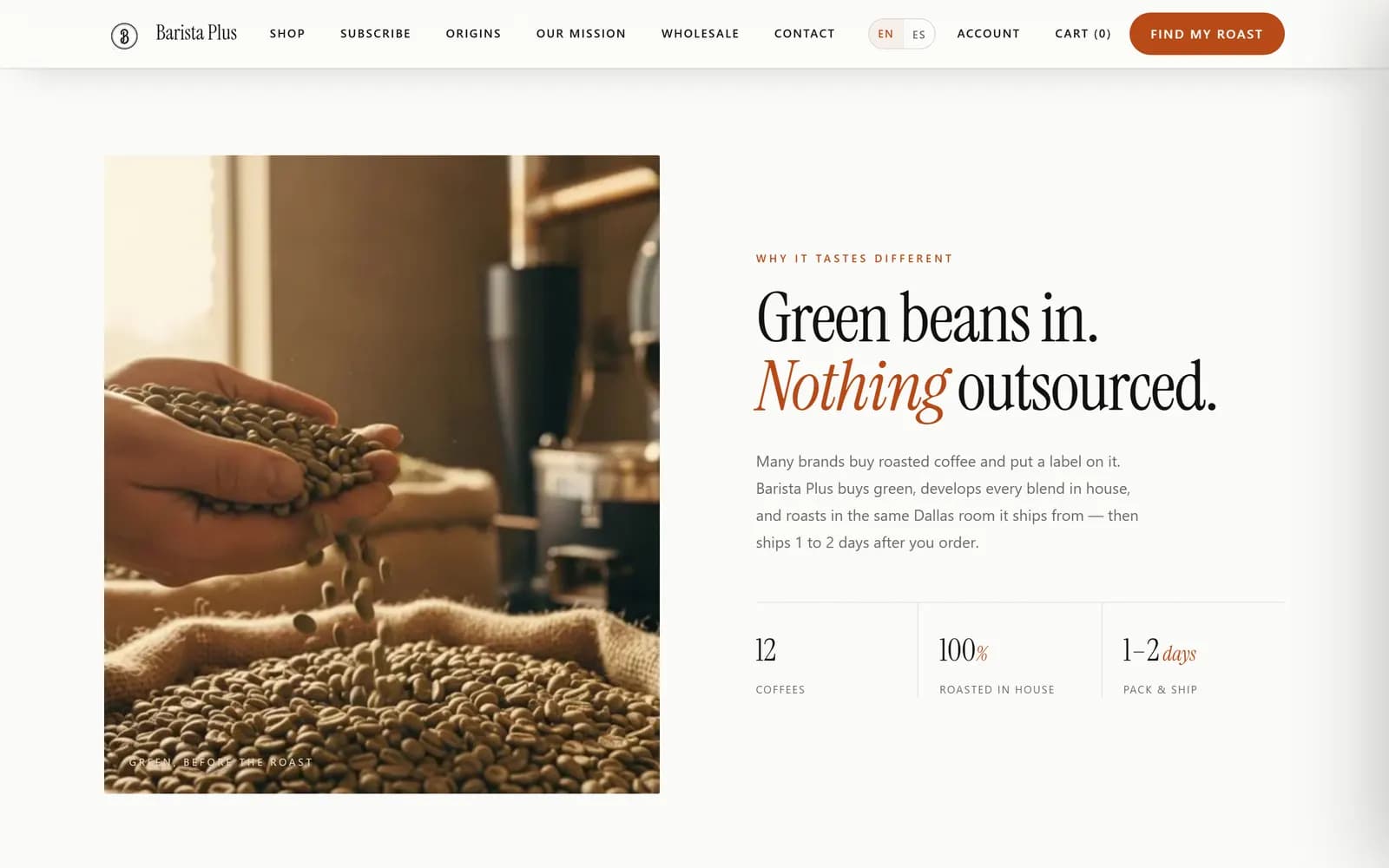
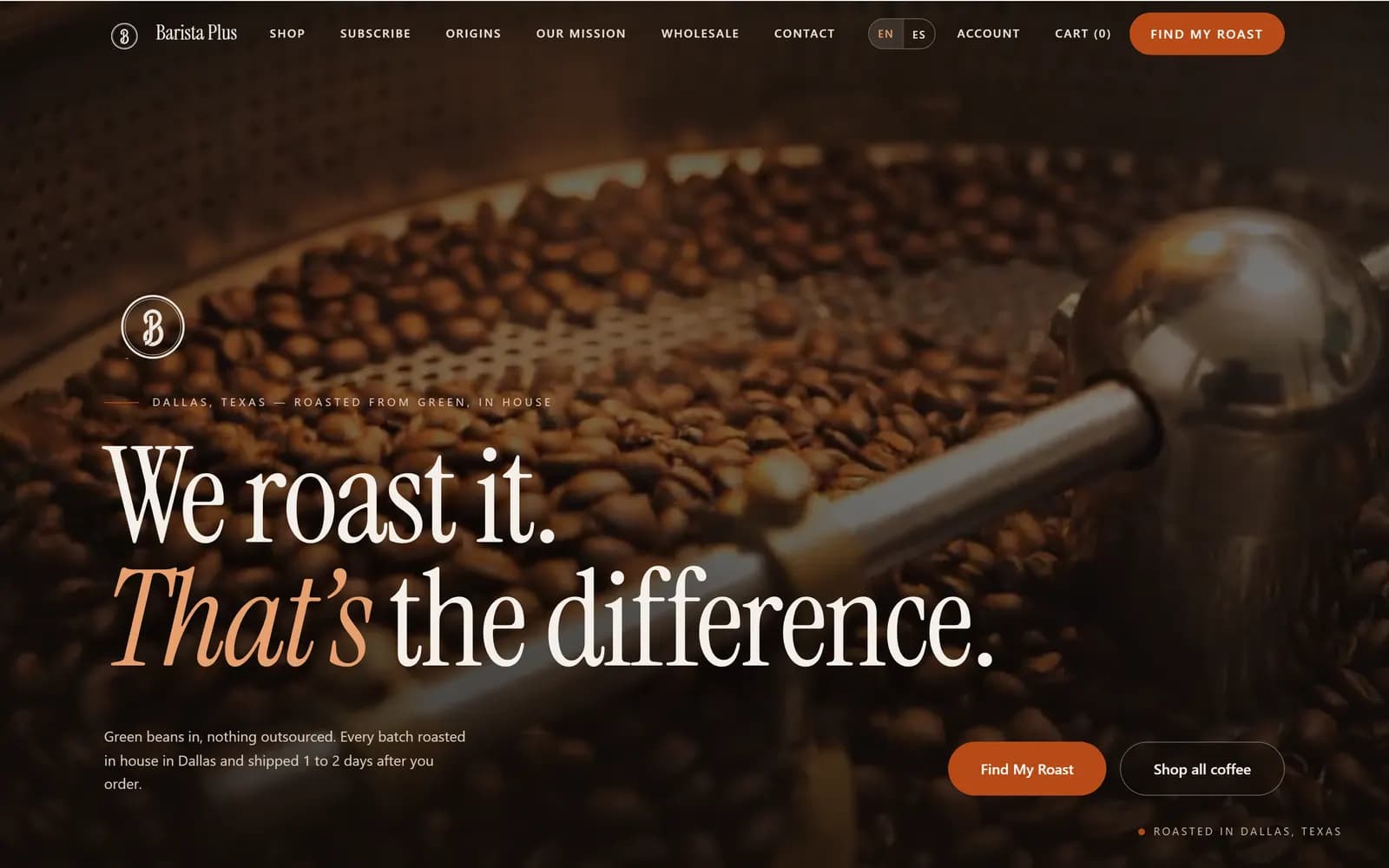
The Barista Plus Coffee home page: coffee beans turning in a roaster drum under the headline We roast it. That's the difference.
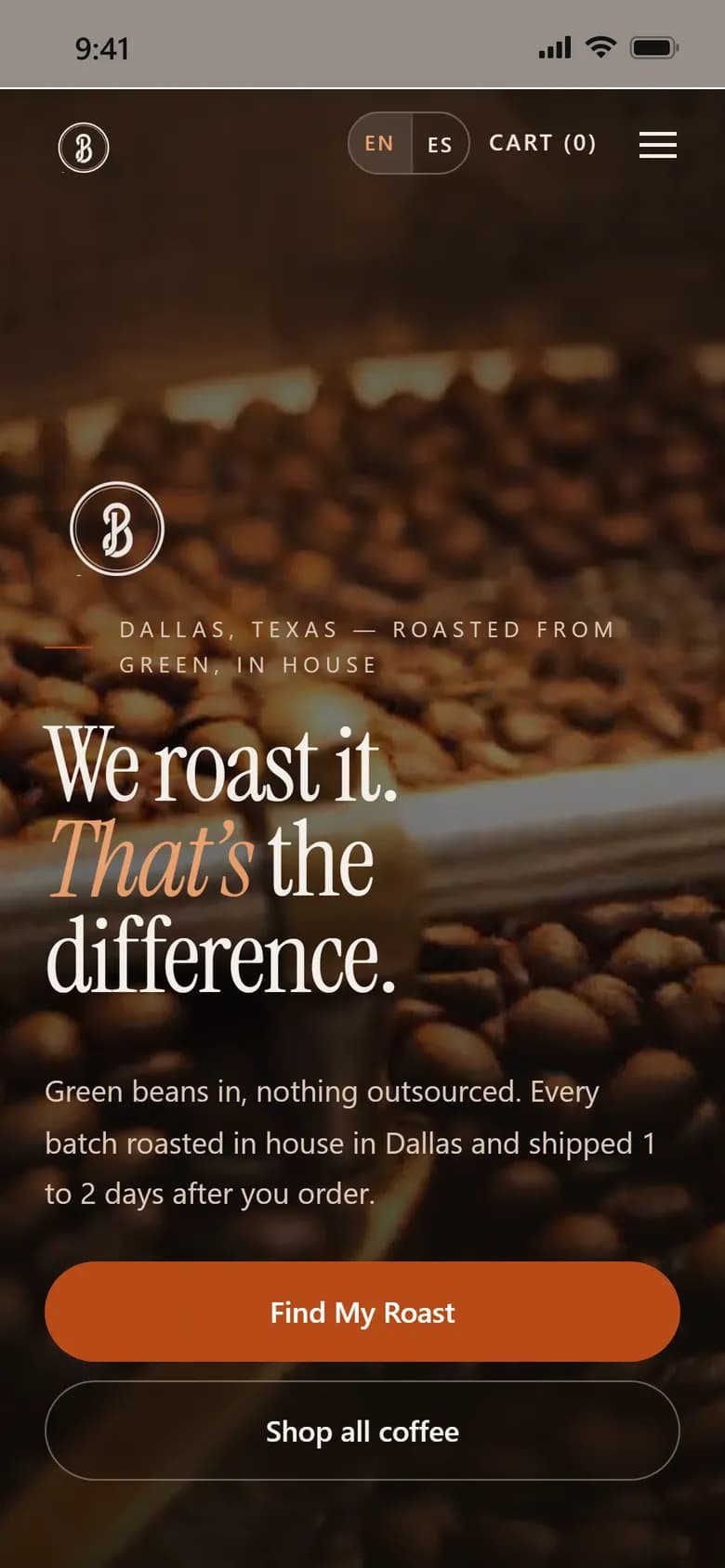
The Barista Plus home page on an iPhone.
92
Google speed score on a phone, home page (was 65)
99 to 100
Google speed score on desktop, every page tested
100
Google SEO score, every page tested
324
bag options: 12 coffees, 3 sizes, 9 grinds
2
languages, English and Spanish

The project in one minute

What they needed
An online store for a Dallas coffee roaster. Twelve coffees, each in 3 sizes and 9 grinds, plus subscriptions, customer reviews, and a checkout with Texas sales tax and shipping set up right.
What we built
A custom Shopify store with all 12 coffees and 324 bag options loaded. Subscriptions customers manage themselves. Live UPS shipping rates and local pickup. Reviews only real buyers can write. A wholesale inquiry form. And the whole store in English and Spanish.
What got better
Google's own test on the live store, September 26, 2026, before and after our speed work: the home page speed score on a phone went from 65 to 92, the main image shows in 2.9 seconds instead of 15.4, and the accessibility score went from 88 to 100. The roast finder now suggests all 12 coffees, up from 9. See the numbers
Working together
About four weeks: we started building on September 1, and the store opened to the public on September 26, 2026. Will and his team chose the design direction and sent the coffee details, bag weights and quiz answers. Will did the owner-only Shopify steps, like connecting the bank. The store and domain are in Barista Plus's own name, and a monthly care plan looks after it now.

See it live: baristapluscoffee.com ↗

01 One team, the whole job

Most web projects are one piece. This was the whole store.

For Barista Plus, one team did the research, design, build, translation, SEO and speed work, start to finish. Will and his team supplied the coffee details and made the calls. Nobody had to manage a list of vendors.

The usual way: hire each piece

  • A designer
  • A developer
  • An SEO person
  • A speed specialist
  • A translator
  • Someone to set up email and Google
  • And you, managing all of them

What Barista Plus got from us

  • Research and a keyword plan
  • A custom design
  • 12 coffees and 324 bag options loaded
  • A roast finder quiz
  • Subscriptions customers manage themselves
  • A wholesale form
  • Live UPS shipping rates
  • Reviews from real buyers only
  • The store in Spanish
  • SEO on every page, in both languages
  • Speed work, measured by Google
  • Accessibility checks
  • Email, Google and analytics set up, payments checked
  • Care after launch
02 The research

The research, before a single page.

The design decisions came from this list, not from a template.

Too much choice for a first-time buyer

12 coffees, 3 sizes and 9 grinds make 324 options. So the store was planned around one idea: open with the roasting, then close with a finder that narrows it down to a few coffees.

Honest about the gaps

We wrote down what the lineup does not have before designing: no light roast, and the blends lacked the detailed tasting notes the single origins had. That way the design never promises something the coffee can't back up.

What buyers actually type

We pulled real Google search suggestions in English and Spanish and matched 28 pages to the phrases people use. We also studied how top roasters like Counter Culture and Stumptown title their pages.

An audit before the copy

Before writing a word for Google, we audited the store and found 21 issues. One would have hurt the launch: 11 pages were about to show placeholder text in search results. Fixed first.

A photo plan with rules

Real roastery footage for the story. Clean product renders for the shelf. Stock photos only for origin countries not yet photographed, and never labeled as the roaster's own farm.

03 The design

Calm, warm, and out of the way.

The design system is called White Roast. A near-white store where color covers less than 5% of any screen, so the coffee and the buttons are what you notice. A classic serif for headlines, a clean small sans for everything you tap.

Things we built this store without:discount popupscountdown timersfake urgency bannersexit popupsspin-to-win wheels
04 The store

Everything a roaster sells, in one place.

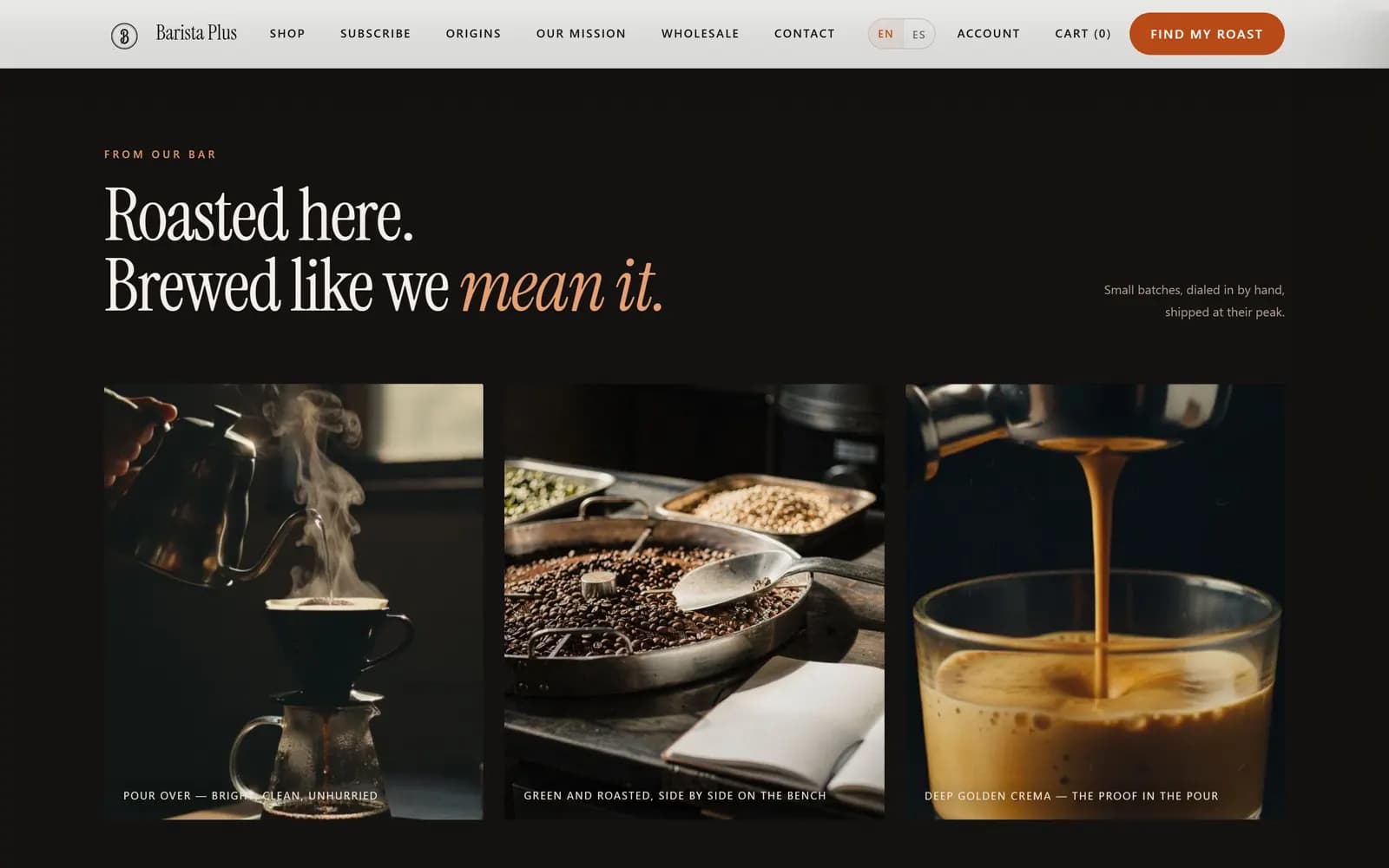
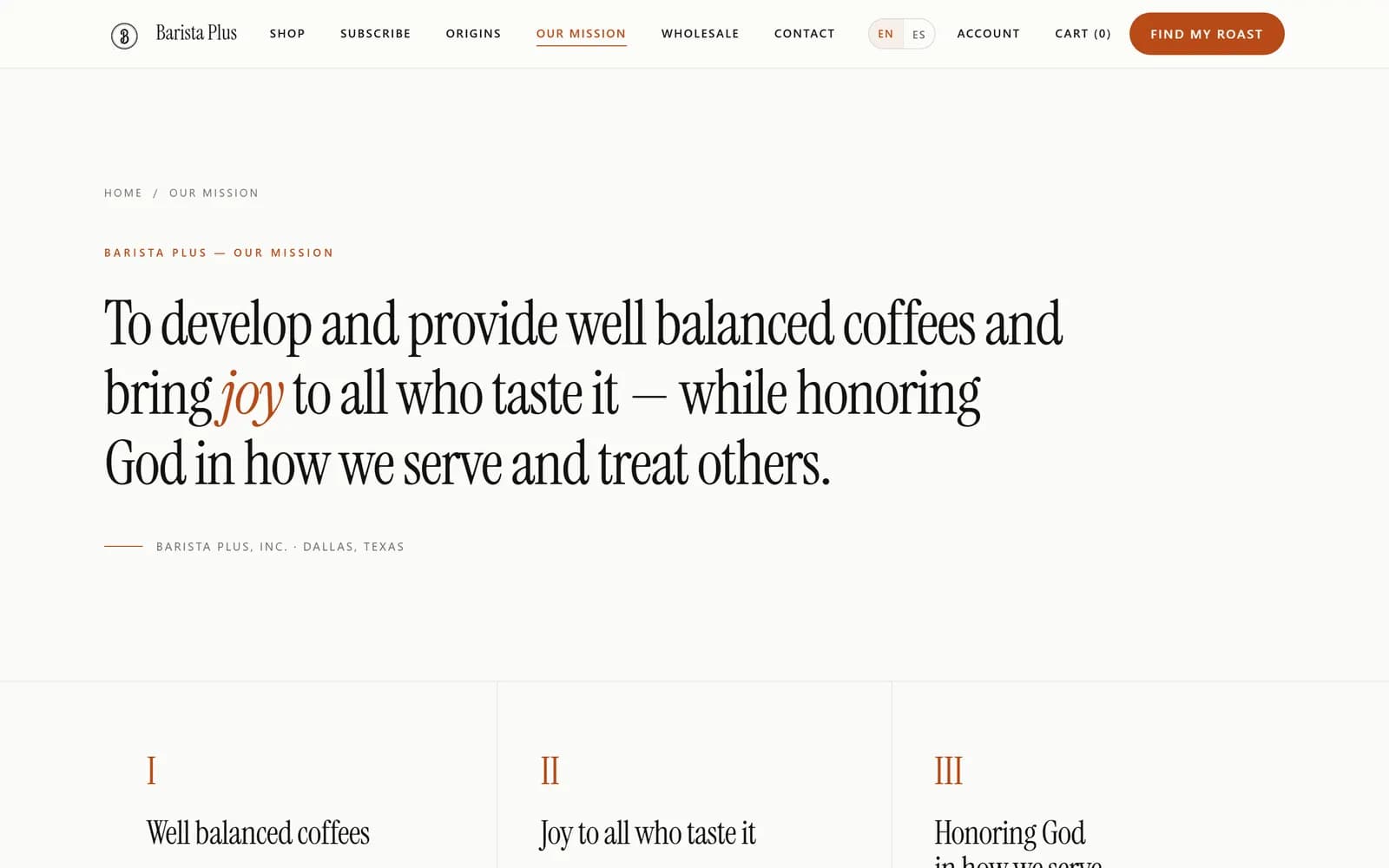
Every screenshot below is the live store, taken on launch day.

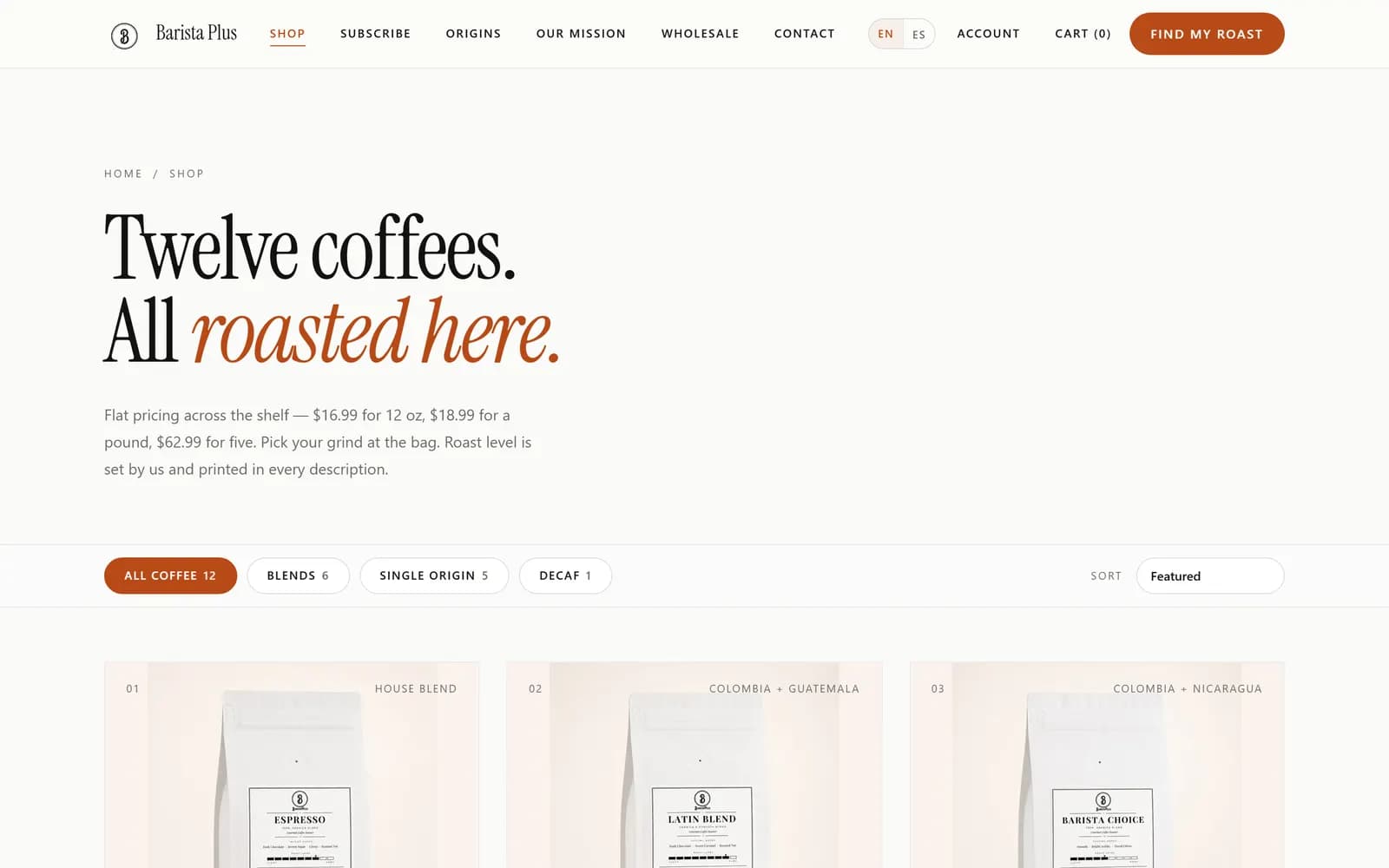
The shelf

Twelve coffees, one clear shelf

Filter tabs for blends, single origins and decaf. Flat, simple pricing across the shelf. Tasting notes and a roast scale on every card, so a customer can compare without opening twelve pages.

The Barista Plus shop page titled Twelve coffees. All roasted here, with filter tabs and product cards.
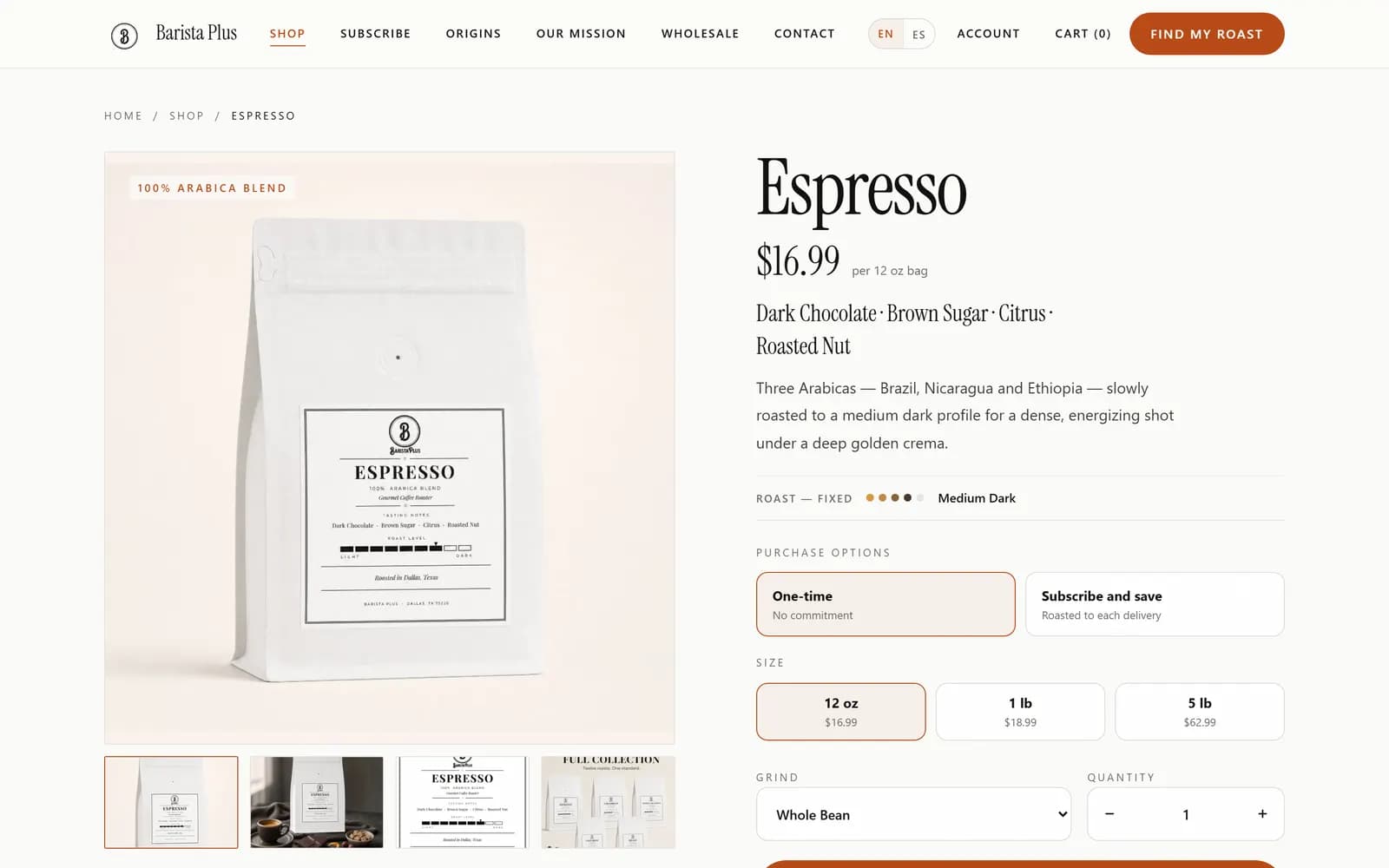
Product pages

Every bag, every grind

Three sizes and nine grinds on every coffee, from whole bean to Turkish. One-time purchase or subscribe and save, right in the buy box. All of it runs on the store's own product data, so adding a coffee never means editing code.

The Espresso product page with size, grind and purchase options.
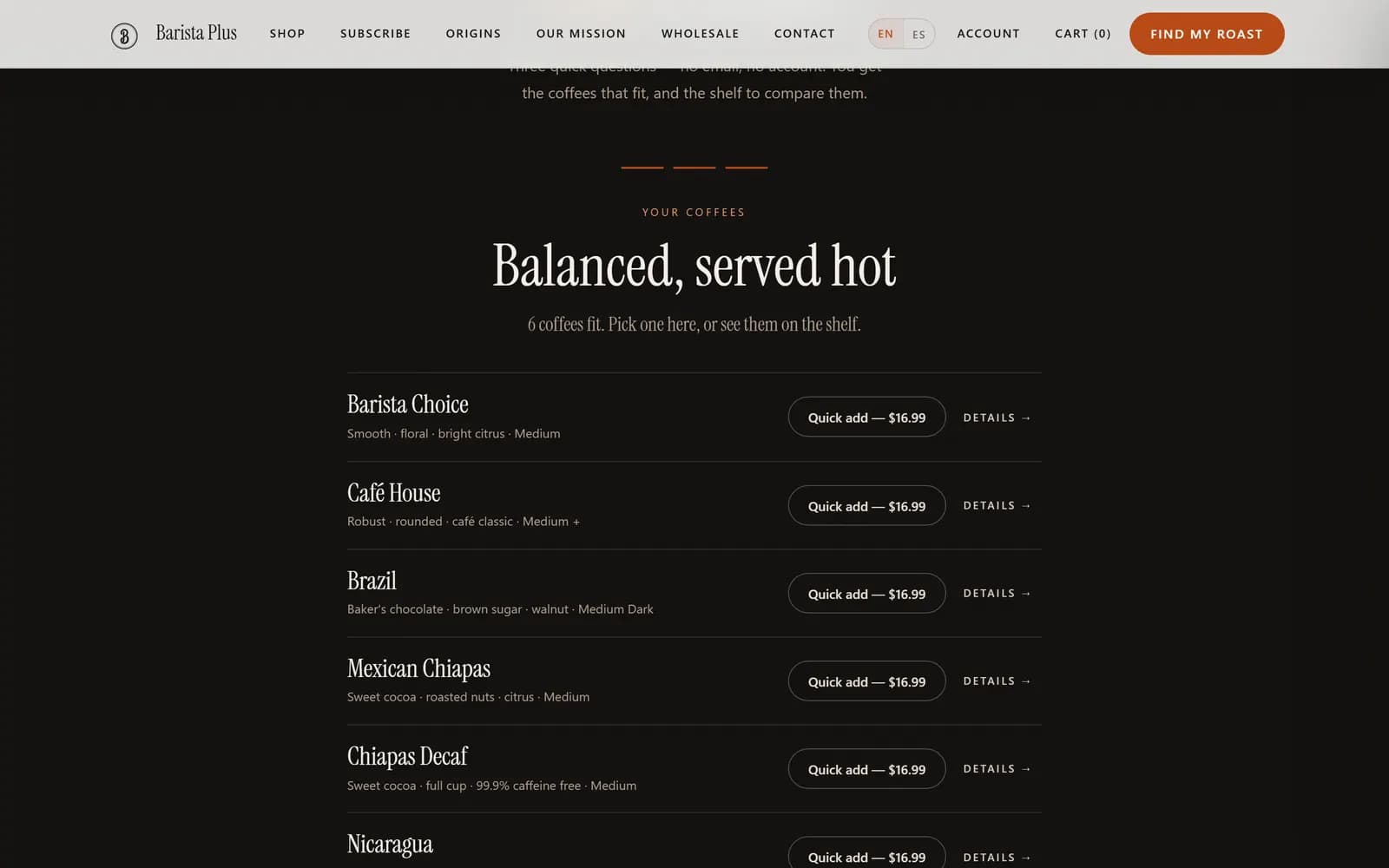
Find My Roast

Three questions. No email required.

How do you brew, hot or iced, how bold. The answer is a short list of coffees that fit, each one ready to add to the cart. It never asks for an email, because the point is to help someone choose, not to trade the answer for an address.

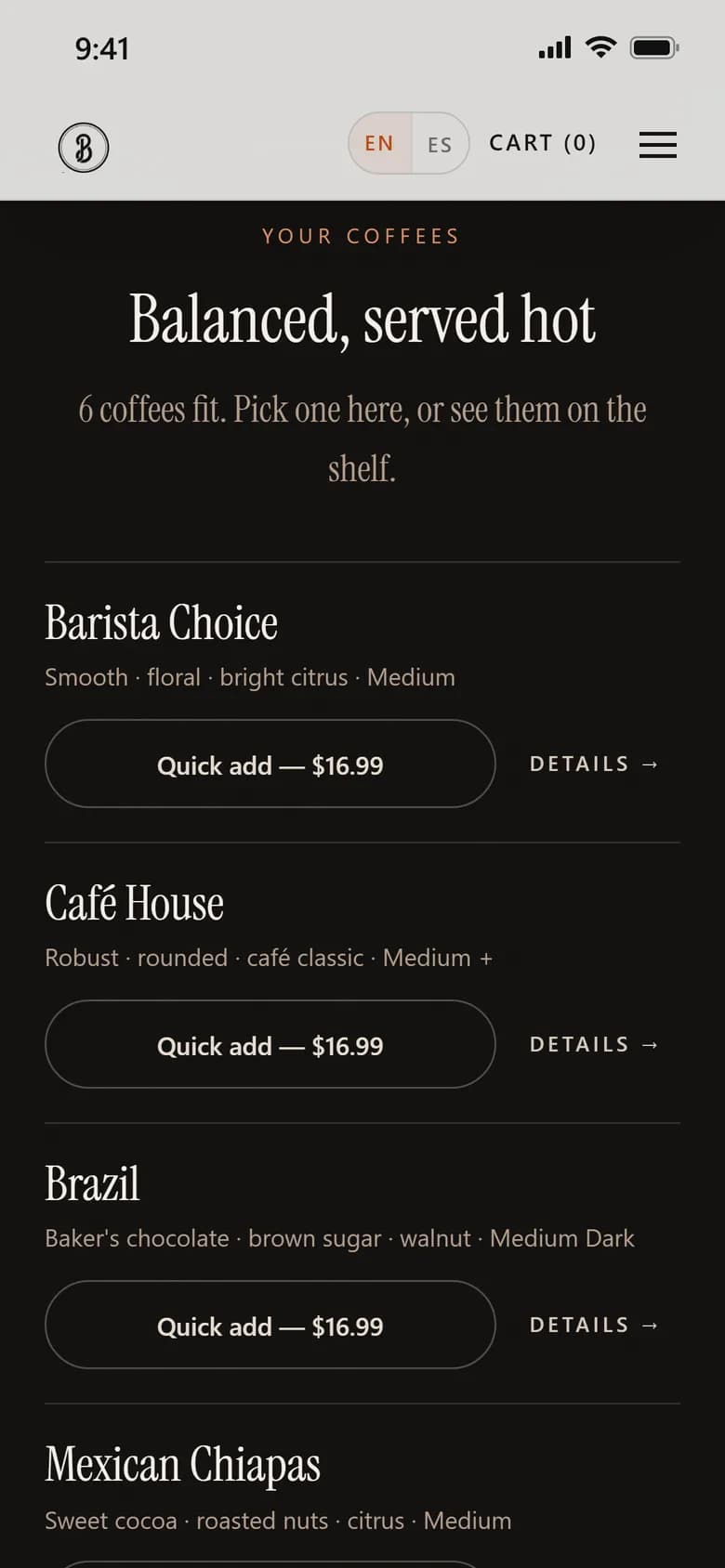
The Find My Roast result, listing six coffees that fit, each with a quick add button.
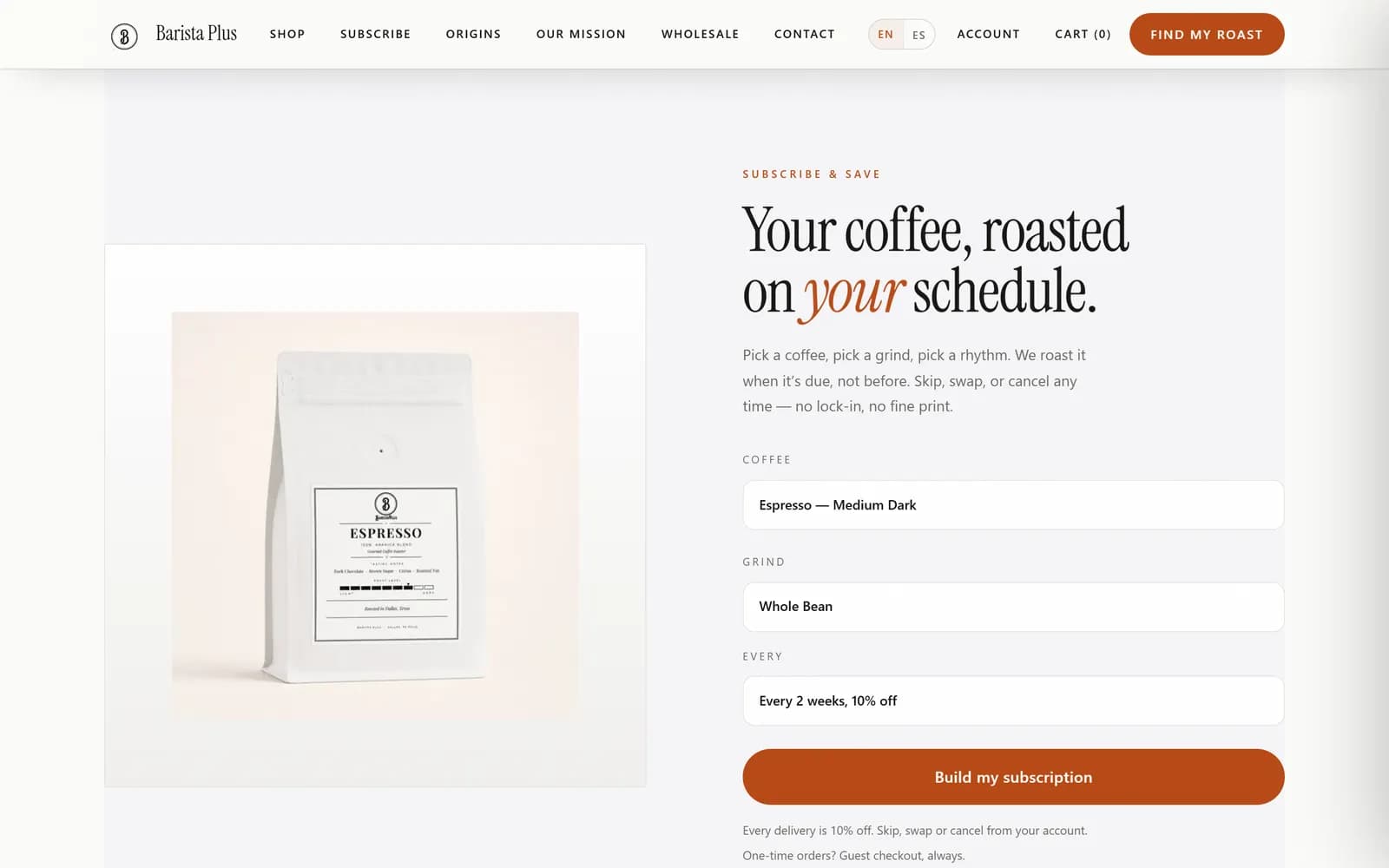
Subscriptions

Coffee on their schedule

Pick a coffee, a grind and how often. Save on every delivery. Customers skip, pause or cancel from their own account, without emailing anyone.

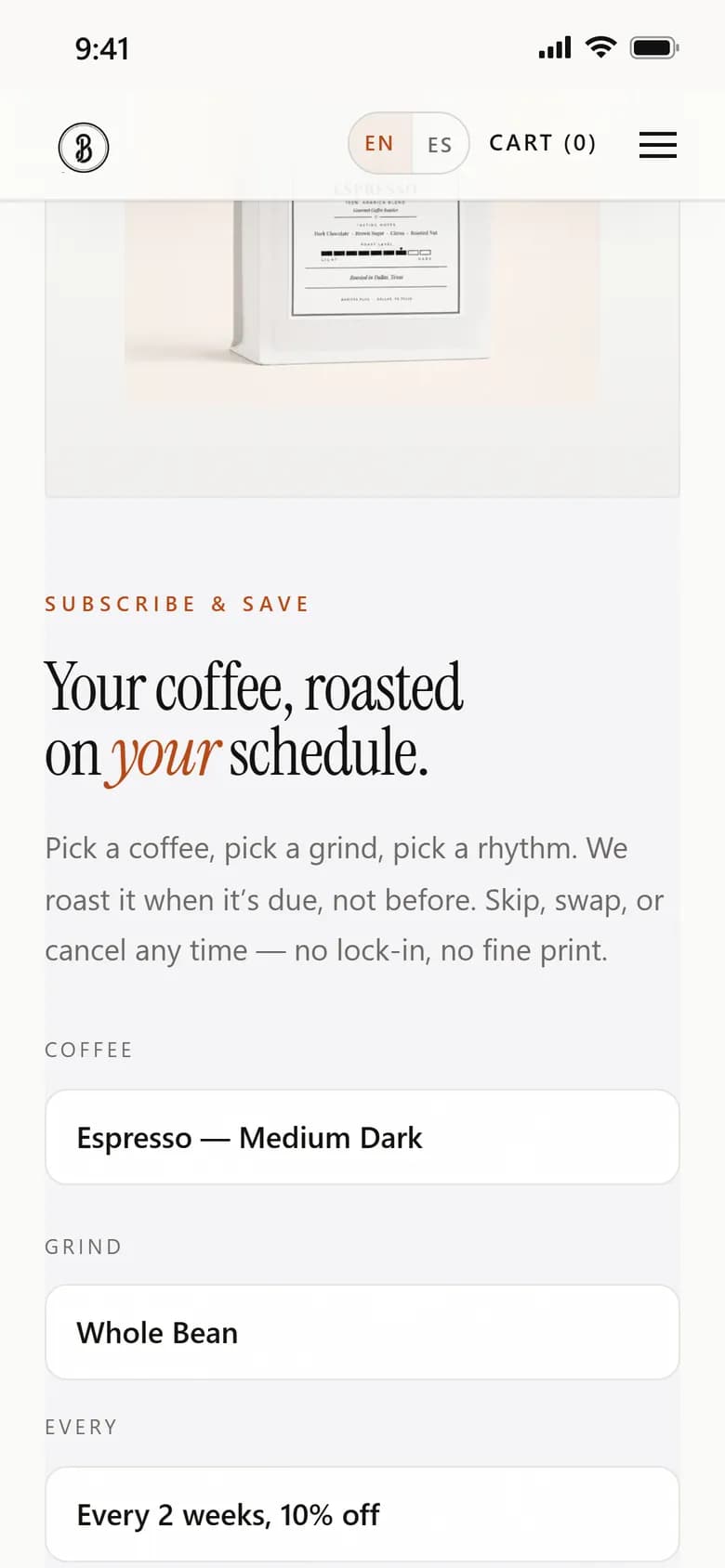
The subscription builder on the home page with coffee, grind and delivery frequency fields.
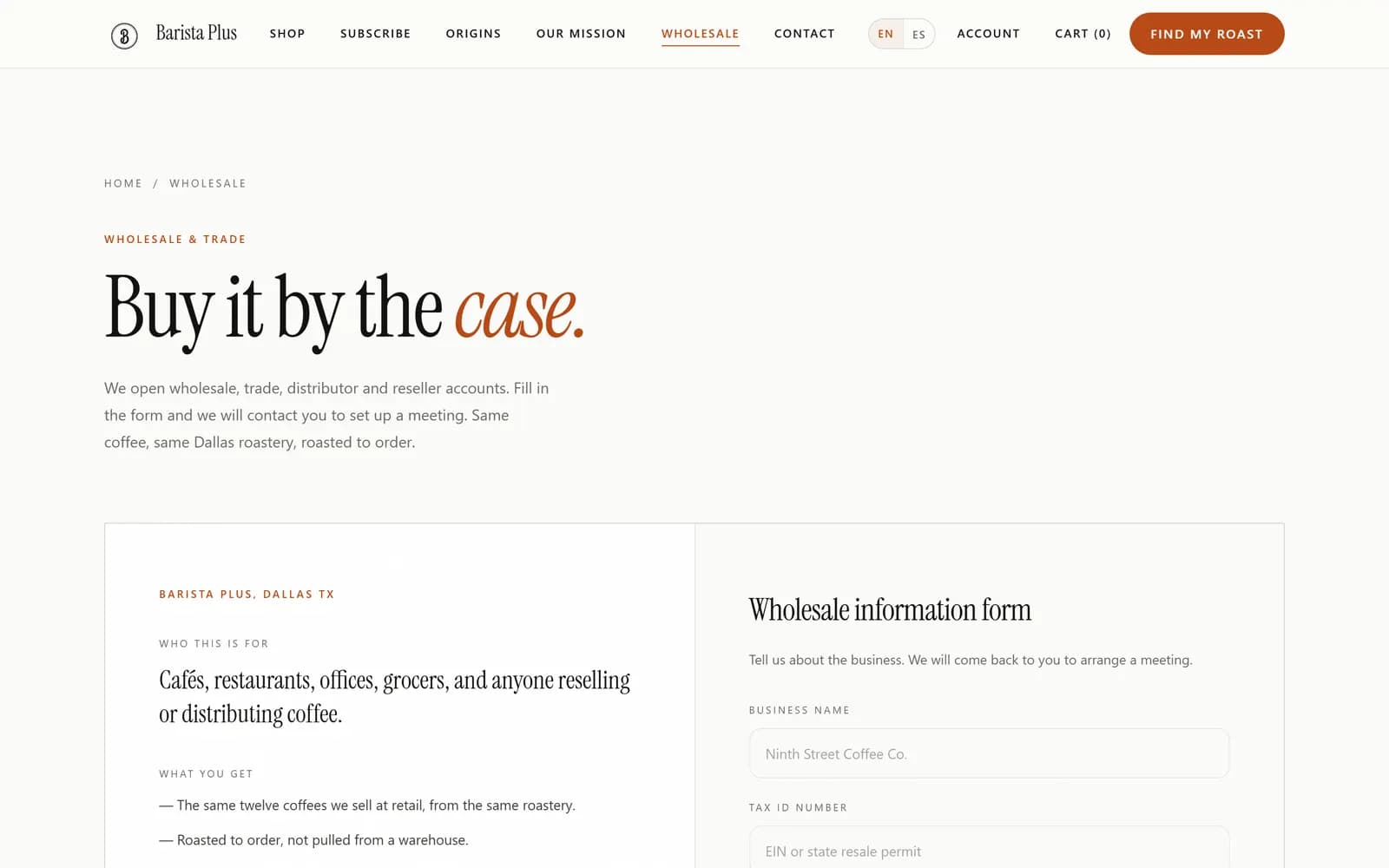
Wholesale

A form that asks the right questions

Cafes, offices and grocers fill in the things a roaster actually needs: monthly volume by product line, brew type and equipment. A form, not a second store, because that is what the owner asked for.

The wholesale page titled Buy it by the case, with the wholesale information form.
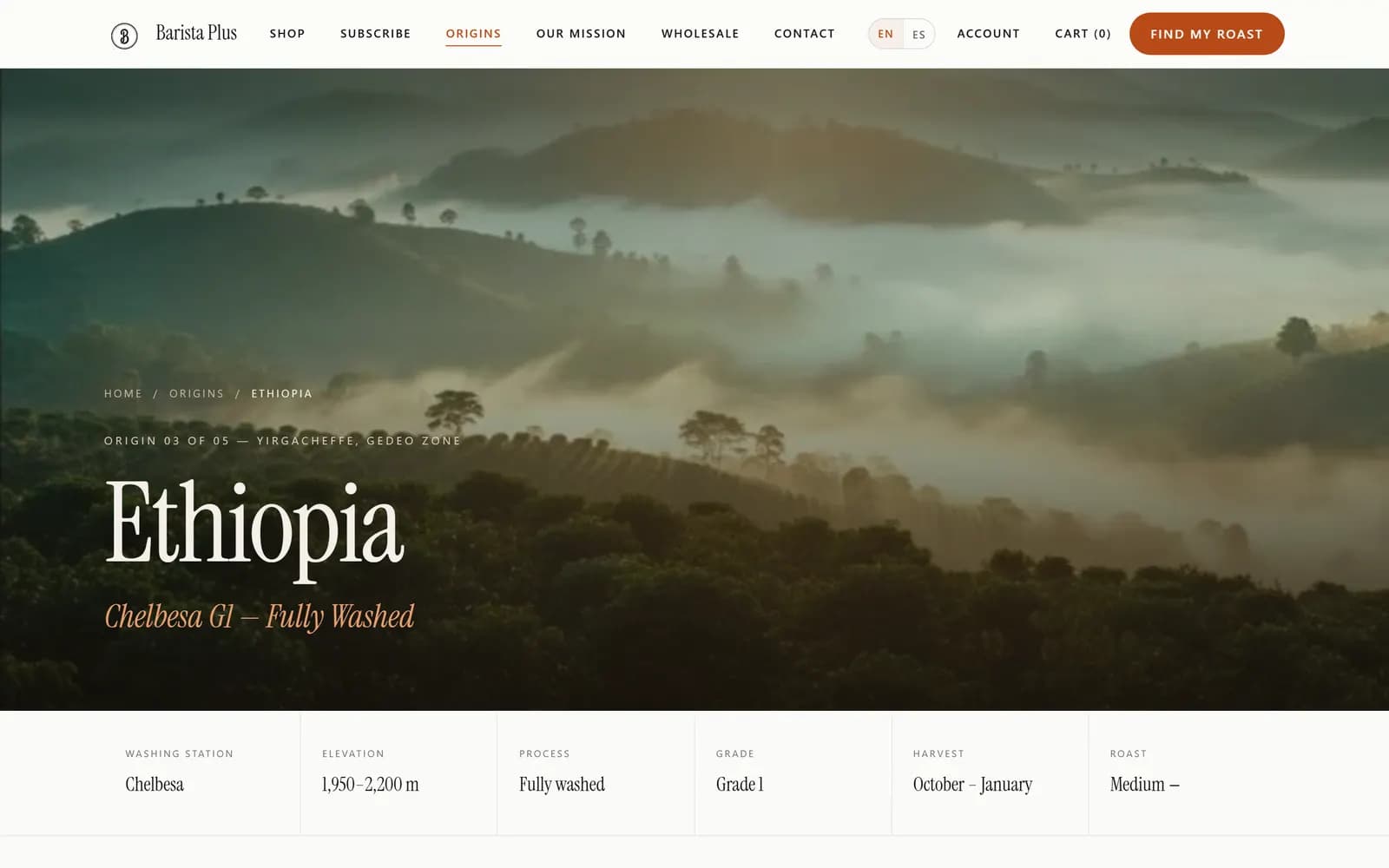
Origins

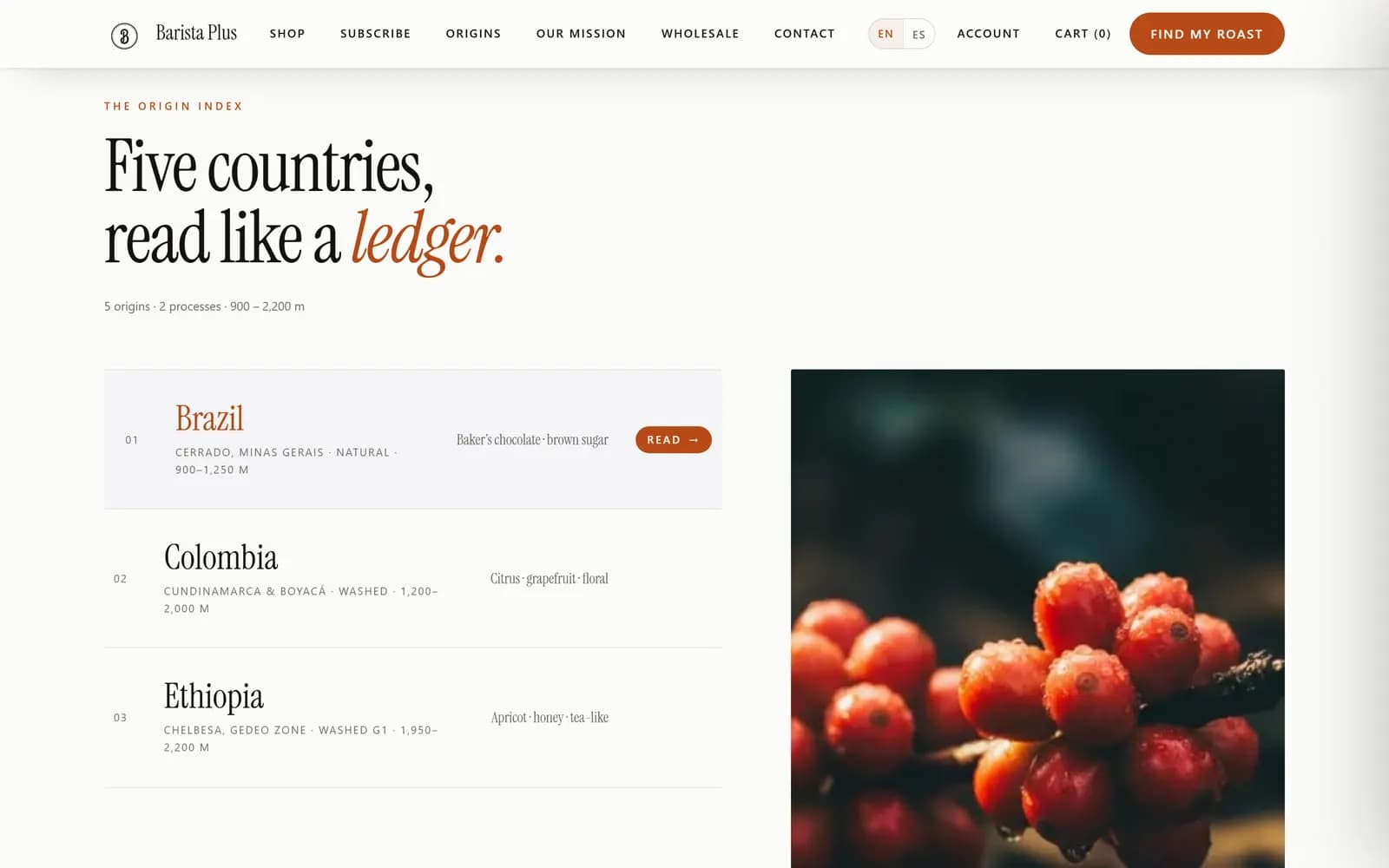
Five countries, told like a story

An origin page for each country, with where it is grown, the altitude, the process and the harvest. It gives the coffee a reason to cost what it costs, and gives Google more real pages to find.

The Ethiopia origin page with a misty hillside photo and details about the farm.

Real shipping rates

Live UPS rates worked out from the actual packed weight of each bag size. Plus local pickup with a written policy.

Reviews from buyers only

Anyone can read reviews. Only someone who actually ordered can write one.

A cart that stays close

A small cart button appears after the first add and stays on screen, along with the header.

Email signups, done right

A footer signup and a checkout opt-in, both tied to Shopify's own consent records.

05 On a phone

Built for thumbs first.

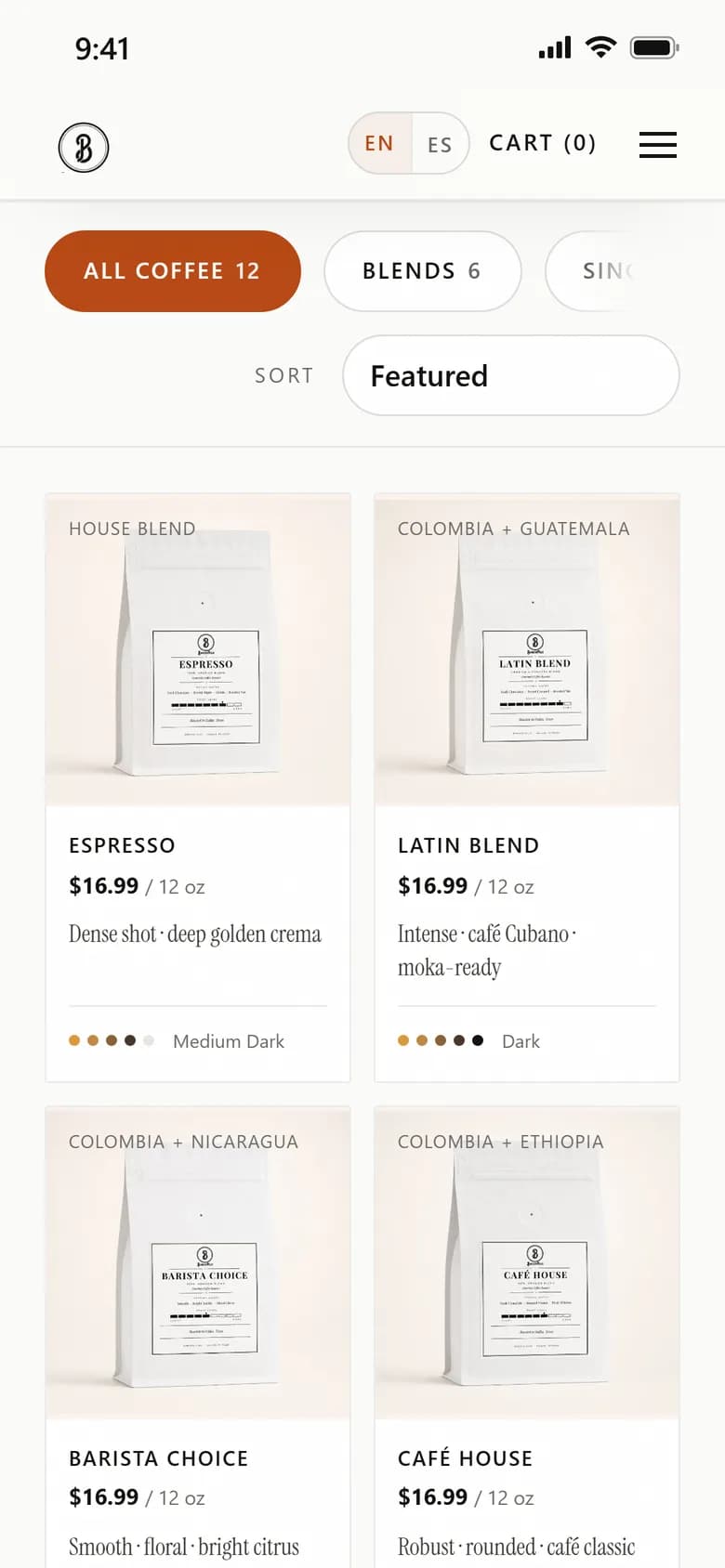
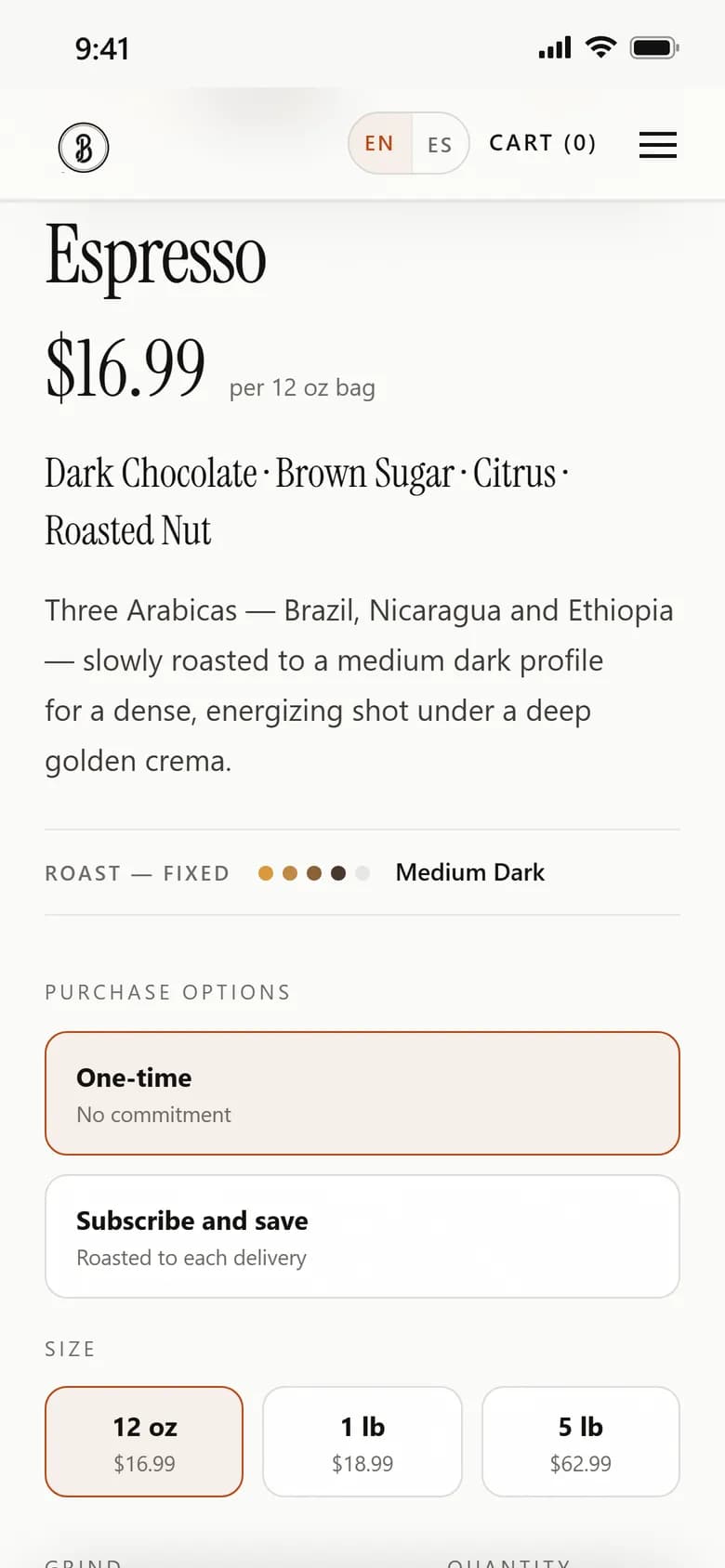
The phone got its own design pass: a two-across product grid, a full-screen menu, a buy button that stays in reach, and form fields big enough that an iPhone never zooms in.

The Barista Plus home page on an iPhone: We roast it. That's the difference, with Find My Roast and Shop all coffee buttons.
HomeThe roasting up front, and two clear next steps.
The shop on an iPhone: filter chips and a two-across grid of coffee bags with prices and roast levels.
ShopTwo across, with price and roast on every card.
The Espresso product page on an iPhone: price, tasting notes, roast level, one-time or subscribe, and size buttons.
ProductPrice, taste, roast and size on one screen.
The Find My Roast result on an iPhone: Balanced, served hot, with a list of coffees and quick add buttons.
Roast finderThree taps to a short list you can add from.
The subscription builder on an iPhone with coffee, grind and delivery frequency fields.
SubscribeCoffee, grind and schedule in one short form.
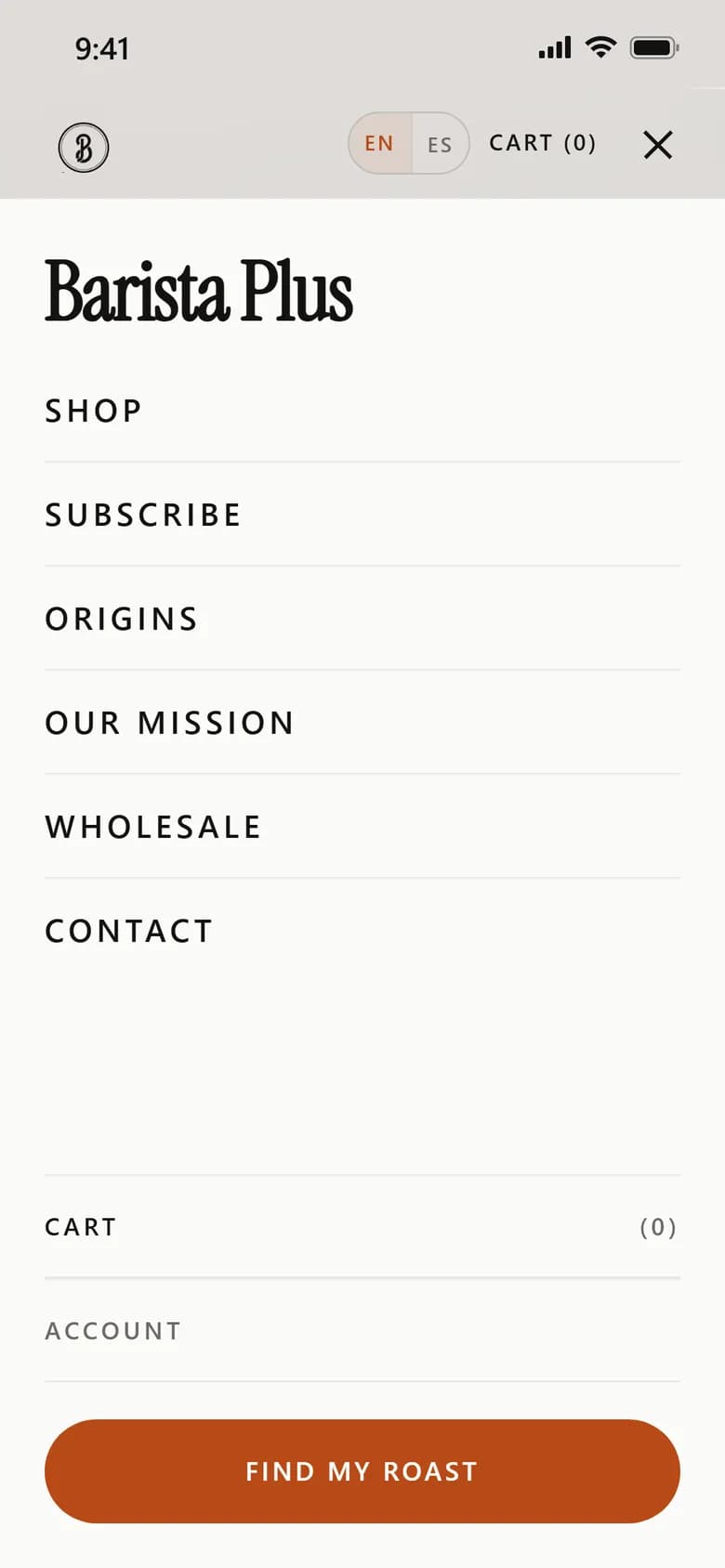
The full-screen menu on an iPhone listing Shop, Subscribe, Origins, Our Mission, Wholesale and Contact.
MenuEvery page in one list your thumb can reach.

Checked by script on 8 pages at 3 phone widths: 24 screens, none that scroll sideways.

06 In Spanish

Lo tostamos nosotros. We roast it.

The store speaks English and Spanish. One tap in the header switches the shop, the product pages and the legal pages.

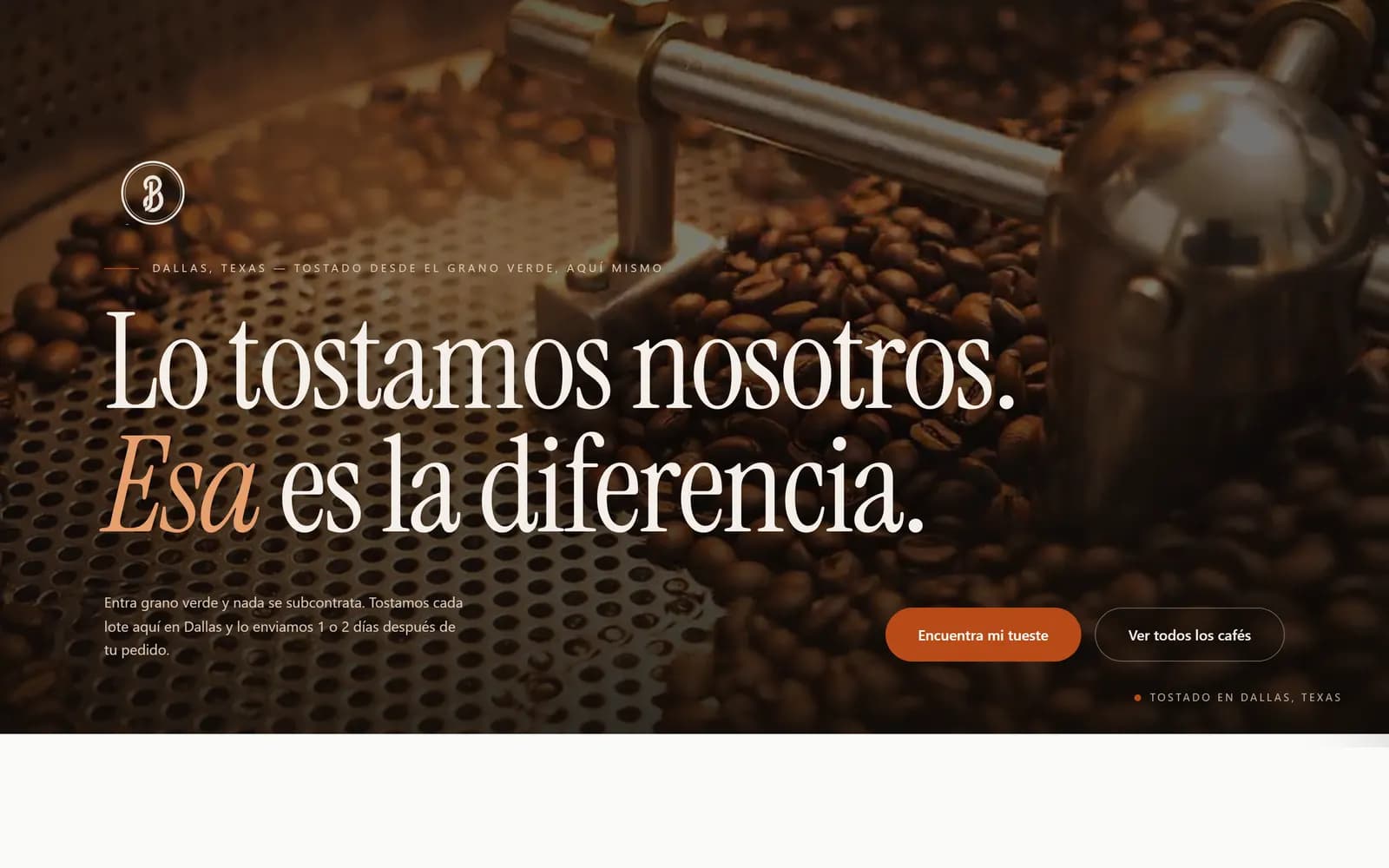
The Spanish home page: Lo tostamos nosotros. Esa es la diferencia.
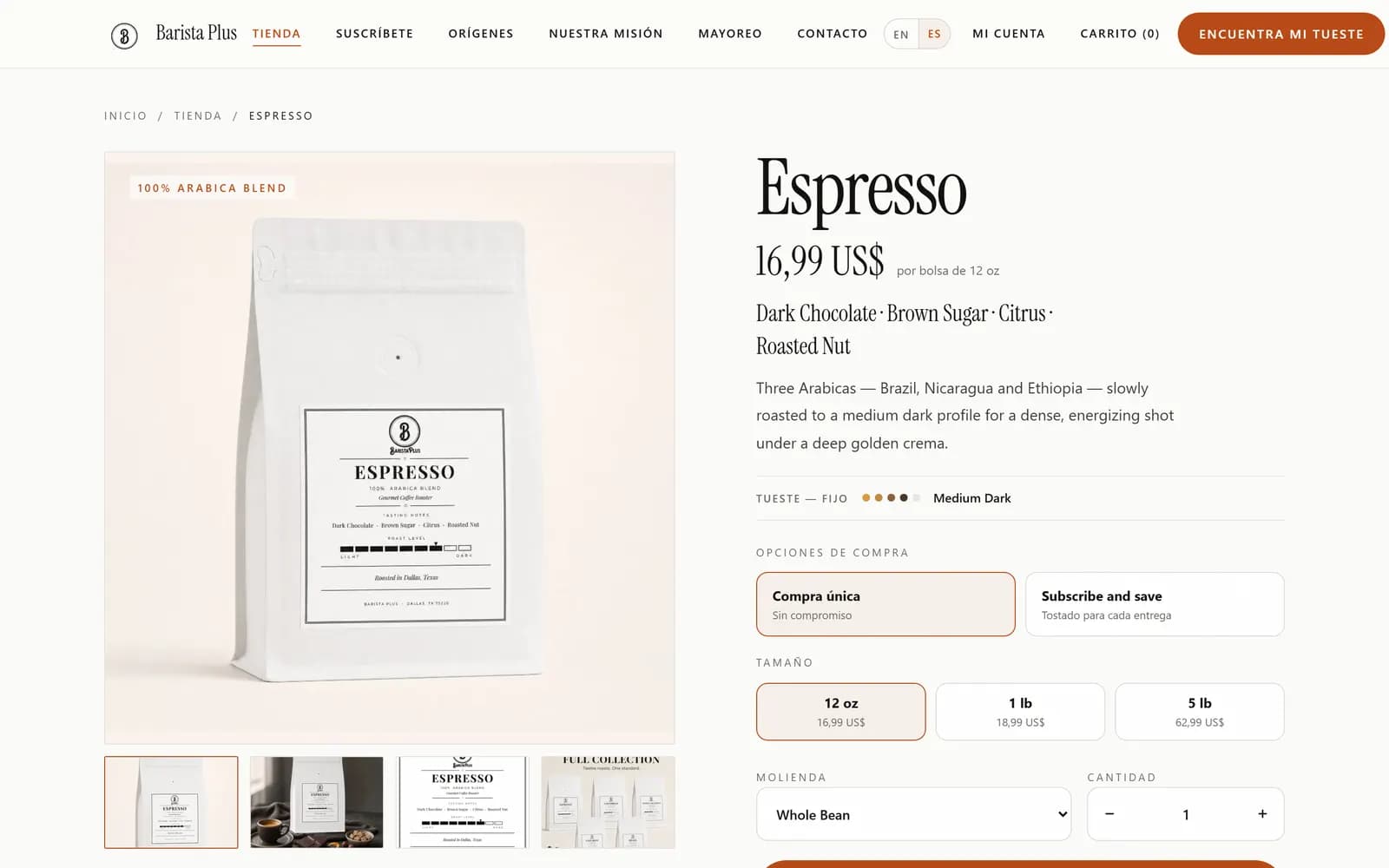
The Espresso product page in Spanish.
926
lines of text, each one in both languages (a script fails if one is missing)
96%
of on-screen text in Spanish, measured by a script that lists every English word left
3
legal pages in Spanish: terms, privacy, shipping
07 SEO

Built to be found.

A beautiful store nobody finds is a hobby. Here is what we did so Google understands every page, in both languages.

  1. Audit first. 21 issues found before launch. The one that would have hurt most: 11 pages about to show placeholder text in Google.
  2. A keyword map. 28 pages, each matched to what buyers type, in English and Spanish.
  3. 54 of 54 titles and descriptions written, saved, then read back from Shopify to prove they stuck.
  4. A hidden label on every page that tells Google who the business is and what each coffee is.
  5. A real headline on every collection. Before, all four shared one line.
  6. Sitemap submitted to Google Search Console (status: Success) and the top pages sent for indexing on launch day.
  7. 34 internal links checked, 0 broken. 0 broken images across 19 pages.
100
Google SEO score

On every page we tested. The home page was already at 100 before the speed work, and it stayed there.

Rankings take months to settle.

08 Speed

Fast on a phone, measured by Google.

Google's PageSpeed test loads a page on a simulated mid-range phone over slow 4G and scores it out of 100. Here is the home page before and after our speed work, on the live store.

92
PerformanceWas 65
100
AccessibilityWas 88
96
Best practicesWas 92
100
SEOWas already 100
Main image on screen
Before: 15.4 s
After: 2.9 s
Page filled in (Speed Index)
Before: 5.8 s
After: 2.5 s

Nothing jumps around while the page loads.

What we did

  • The home page video was the slowest thing on the page (1.3 MB). A still frame now shows first and the video starts after.
  • Every image comes in the right size for the screen, instead of one large file for everyone.
  • Photos below the fold wait until someone scrolls near them.
  • We deleted 91 unused files from the base theme.
  • The page no longer waits for every style file before it shows anything.
  • The reviews widget loads when a reader gets close to it, not before.

Every page we tested

PagePhoneDesktop
Home page9299
Shop95n/a
Subscribe94100
Product page (Espresso)80 to 8299
Origin page (Brazil)8199

Google PageSpeed Insights, live store, September 26, 2026, single runs. Scores move by up to about 10 points between runs, so treat each one as a snapshot. Product pages sit in the 80s on a phone: most of what is left is Shopify's own checkout and tracking code, which every Shopify store loads. Run the test yourself ↗

09 Accessibility

Easy to use for everyone.

Readable text, buttons a thumb can hit, and a store that respects people who ask their phone for less motion. If someone has turned on reduced motion, the home page video does not even download. One bug we found live: the footer language switch was near-white on near-white. Fixed.

44 to 0
text color contrast failures, fixed in the finishing pass
88 to 100
Google accessibility score, home page
44 to 1
tap targets smaller than a fingertip on a phone
9 to 0
form fields small enough to make an iPhone zoom in
10 The launch

Behind the scenes, handled.

The parts nobody sees and every store needs. We set up and checked all of it. The owner only did the steps Shopify requires of an owner, like connecting a bank account.

Email from the store's own domain

All 6 of Shopify's email records added and confirmed, so order emails come from Barista Plus.

One clear email rule

The rules that tell inboxes whether to trust the store's mail disagreed. We left one clear rule in place.

Payments live

Shopify Payments on, test mode off, checked before the doors opened.

Google Search Console

Domain verified, sitemap submitted (status: Success), top pages sent to Google on launch day.

Analytics

Google Analytics and Microsoft Clarity, so we can see what visitors do.

Doors open, checked from outside

Password removed, then checked with a request that carries no login, which returned the real home page.

Care after launch

Barista Plus is on a monthly care plan. The store keeps getting looked after.

11 How we checked it

Checked, then checked again.

208 logged changes between September 1 and launch day. Scripts checked the work as it went, and a second reviewer, whose only job is to prove us wrong, re-checked the big rounds.

What the checks caught before customers did

  • The roast finder could only suggest 9 of the 12 coffees. Now it reaches all 12.
  • Product pages promised reviews from real buyers only, but the reviews app let anyone post. We built the block the page promised.
  • Shipping was priced on Shopify's sample box. Rates now use the real packed weight of every bag.
  • The Spanish said “store” where it meant “roastery.” Fixed in all 10 places.
  • An empty cart still showed a checkout button. Now it shows nothing to check out.

Our own mistakes, and what we did

One early phone fix pushed every phone wider than 381px onto the desktop layout. Our phone scan caught it, and we fixed it the same session.

We once reported a phone speed score of 97 to 98. The test had reused files it already saved, which flatters the result. We withdrew it the same morning. Every speed score on this page is Google's own test on the live store.

See all ten problems, and the checks we run
01

The roast finder could only suggest 9 of the 12 coffees

The owner's team told us the finder felt limited. Three coffees could never be the answer, whatever you picked.

What we did: We rebuilt it to return the short lists they asked for, checked every answer against their lists, and now all 12 coffees are reachable.

02

On a phone, the finder jumped away from the answer

After a result, the page scrolled on its own and left people looking at the wrong part of the page.

What we did: We removed the automatic scroll. The shelf is now one tap away, and the answer stays where you can read it.

03

The page promised something the reviews app didn't do

Product pages said every review comes from a real order. Out of the box, the reviews app let anyone post, and it has no setting to require a buyer.

What we did: We built what the sentence promised: reviews come in through the app's after-purchase email, and the theme itself blocks everyone else.

04

A “Write a review” button that went nowhere

It belonged to a dead part of the reviews app. Making it work meant hooking into hidden code that could break without warning.

What we did: We took it out and said so, instead of leaving a button that looks like it works.

05

Shipping was priced on a sample box

Rates were based on Shopify's generic example package, not what a bag of coffee weighs.

What we did: We asked for the real packed weights and rebuilt the rates on them. All 324 options now carry a real weight.

06

The home page took 15 seconds to show its main image on a phone

On Google's slow-phone test, the biggest thing on the page appeared at 15.4 seconds. Most of the base theme's style code loaded whether a page used it or not.

What we did: Still frame first, video after, 91 unused files deleted, styles moved out of the way. The main image now appears at 2.9 seconds.

07

The Spanish said “store” where it meant “roastery”

A wording sweep turned “local pickup” into “pick up in store” in 10 places, including the terms. Pickup is at the roastery, not a shop.

What we did: Our checker caught the new fact in the translation. We changed it to in-person pickup everywhere.

08

The home page still said subscriptions were “coming soon”

Subscriptions were live on product pages, but one block on the home page hadn't caught up.

What we did: That block now reads the live subscription plans, the same as the rest of the store.

09

An empty cart still showed a checkout button

A zero-dollar checkout is confusing for a person and an open door for bots.

What we did: An empty cart now shows no order summary and no checkout button.

10

One of our own fixes broke phones

An early mobile change pushed every phone wider than 381px onto the desktop layout.

What we did: Our automated phone scan caught it and we fixed it the same session. The mistake matters less than the fact that something was watching for it.
Automated checks we run on the store

  • Every line of text exists in both English and Spanish
  • The language switch works at every screen width, from 320px up
  • Lists every English word left on the Spanish site
  • Finds text a desktop visitor can read that a phone visitor can't
  • The roast finder returns the right coffees for every answer
  • The menu fits, the header stays put, the footer switch works
  • No sideways scrolling and no zoom-trigger fields on phones
12 Results

No revenue numbers yet.

The store opened on September 26, 2026. We have no sales results to share yet, and any we share later will have Barista Plus's permission. We'd rather show you the work than guess at the results.

Barista Plus owns the store and the domain. Shared under our agreement with Barista Plus.

See what a comparable store includes and costs · See what else we build · For coffee roasters

Your store next?

Want this for your store?

Start small. Send us your store and in 2 business days you get a short video showing five things that may be costing you orders, easiest fix first. Free, no call needed.

If this week is full, we'll tell you the day yours will arrive.

Or book a free 30-minute call.

Thirty minutes about your store. Free.

Sheraz GandhiYou talk to Sheraz.Sheraz Gandhi, co-founder.